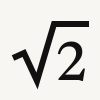
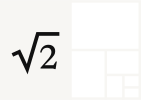
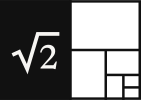
1.41421356237309504880…
Sample report · Production Triage
Production Triage report
Covers one system: the GreenRoom V1 to V2 migration, reviewed before cutover.
xxxxxxxxxVendor names, component names and some figures are blacked out, as they are in any report we share beyond the client who commissioned it.
SampleNot a client engagement. This report triages GreenRoom V2, a professional network for the music industry built by GreenRoom Technologies, Inc. Our founder is its founding engineer. V2 is in private beta, V1 is still live, and the production cutover is pending. The findings date from before the migration work. Client reports follow this structure, scoped to your system and your decision.
 Irrational Solution
Production Triage · Sample report
Irrational Solution
Production Triage · Sample report
Summary
Do not cut over on the plan as it stood at review. The target design, a Postgres graph in four layers, is sound. Two critical risks made the execution path an unacceptable bet on data that cannot be re-created: an identity bridge that was assumed rather than checked, and an ETL that was not safe to re-run.
The fix plan has four items. F1 to F3 come before any cutover. F4 ships alongside, so the discovery feature V2 is built around is protected from the first day.
- 2critical
- 2high
- 1medium
System snapshot
What exists, taken from code and infrastructure rather than from documents.
V1 stays available while V2 is built and tested. Account history and sign-in continuity both have to survive the cutover.
Findings, ranked by risk
Ranked by blast radius and likelihood. Each finding is tied to a named component. In a client report the evidence column cites file paths, queries and run output; here it is summarised.
Sign-in continuity could break at cutover
CRITICAL- Where it lives
- xxxxxxxx to Postgres identity bridge
- Evidence
- The plan assumed xxxxxxxx sessions and UIDs would carry over for legacy V1 accounts. Nothing checked that mapping, and xxxxxxxx sessions do not transfer to the V2 auth system.
- Blast radius
- Legacy users locked out of their paid history, a support backlog, and lost trust in the cohort V2 most needs to keep.
The ETL was not safe to re-run
CRITICAL- Where it lives
- xxxxxxxx to Postgres migration jobs
- Evidence
- Rows were inserted without deterministic keys, so a partial failure followed by a re-run could write a second copy of the same record.
- Blast radius
- Duplicate or conflicting records across every table the ETL writes, and manual clean-up of each one.
No rollback once V2 accepts writes
HIGH- Where it lives
- Cutover plan
- Evidence
- No reverse migration was designed, and nothing prevented V1 from changing underneath a load.
- Blast radius
- Any defect found after cutover becomes a forward-fix emergency instead of a controlled revert.
Discovery has no evaluation harness
HIGH- Where it lives
- Natural-language discovery layer over the graph
- Evidence
- No fixed set of queries with expected matches existed, so a change to a prompt or model could not be compared with a baseline.
- Blast radius
- The feature V2 is built around gets worse without anyone noticing until users stop trusting it.
No per-stage visibility in the migration
MEDIUM- Where it lives
- ETL pipeline
- Evidence
- Success was inferred from the absence of errors, not from checks showing that the loaded data matched the source.
- Blast radius
- Silent data loss found weeks later, when it is expensive to trace.
Fix plan
Each risk becomes a bounded work item with an acceptance check. Written so any senior engineer could carry it out, not only the one who wrote it.
Read-only dry run of the identity bridge
addresses R1 · about 3 daysRun a read-only pass over every legacy V1 account against the V2 identity data, and produce an exceptions list before any cutover. Use a lazy credential bridge: a V1 user signs in with their existing password and the V2 account is created at first login. Accounts that fail mapping get a re-link flow designed now, not during an incident.
Deterministic keys and a verify suite
addresses R2, R5 · about 4 daysGive every migrated record a deterministic uuid5 key derived from its source identity, and write with ON CONFLICT so a re-run changes nothing. Add a dry-run mode and a read-only verify suite that reports counts per stage, so each run can be audited and resumed.
Freeze V1 during loads, with manifest-based rollback
addresses R3 · about 5 daysHold V1 read-only for the length of each load so the source cannot move underneath it. Record a manifest of every row a load writes, so a rollback removes exactly those rows and nothing else.
A minimal evaluation tripwire for discovery
addresses R4 · about 3 daysFreeze xxx real goal-resolution queries, each with its expected profile matches, into a regression suite that runs on every merge. Pin the model version, set temperature to 0, and cache retrieval results, so a change in score means the system changed and not the noise around it. This is a tripwire, not a research project.
Where the system stands
This page does not claim the migration is done. V2 is in private beta, V1 is live, and the production cutover is pending. What has been built so far on the GreenRoom V2 migration path:
- Deterministic uuid5 IDs, with ON CONFLICT writes so re-runs are no-ops.
- A dry-run mode and a read-only verify suite.
- A field-level parity audit.
- Manifest-based rollback, and V1 frozen read-only during loads.
- A lazy credential bridge, with a reconciliation gate that held back conflicting rows instead of loading them.